
After line and matrix comes the Symbiotic Organization
Why "just get started" is sometimes wrong with AI, why roles matter, and which form of organization answers that
First published 29 October 2026 · Dipl.-Ing. Michael Kraewing · Version 1.0
The line organization settled who reports to whom. The matrix organization settled how functions and initiatives work across each other. Both answer the same question, namely how people in an organization work together. AI adds a new one. How do people and AI work together so that the organization can do something it could not do before, and so that this capability stays when individuals leave?
I approach this question from two directions. I bring over 25 years of operational practice in industrial companies, as interim manager and as program lead for digital initiatives. And today I lead AI teams every day across different areas of work. Here I set out what I have found so far, and the term under which I am developing the answer. By the end you will know how to tell which level your organization is at, and which questions you should settle next.
Introduced, but without effect
Many companies have introduced AI and see little of it. Two findings explain why.
In a 2024 meta-analysis, Vaccaro, Almaatouq and Malone evaluated 106 experiments with 370 effect sizes. On average, the combination of human and AI performed worse than the better of the two alone (Hedges' g = minus 0.23). The combination lost on decision tasks and tended to gain on tasks in which something is created. Who takes on which task therefore matters. That clear roles make the difference is my conclusion from these findings; the study did not measure roles.
The second finding comes from Project NANDA at MIT. Its 2025 report is preliminary and not peer reviewed, so its figure of 95 percent of organizations without measurable return should be read with care. The authors' explanation is more robust. In their words, "The core barrier to scaling is not infrastructure, regulation, or talent. It is learning." Most systems, they write, do not retain feedback, adapt to context, or improve over time. Every correction therefore has to be made again next time instead of becoming part of the way of working.
For me it follows that an introduction without roles is not a harmless first step. It can push the result below what the human or the AI would have achieved alone. I therefore consider "just get started" the wrong advice for AI as long as no one settles the roles. Starting is right; starting without roles is not.
The term
Since October 2026 I have used the term Symbiotic Organization for a form of organization in which people and AI teams work together in fixed roles. Four features belong to it.
- Fixed roles. For every task it is set who drafts, who reviews and who approves, regardless of whether a person or an AI holds the role.
- Each remains what it is. People bring judgment, experience and responsibility; AI brings speed, breadth and stamina. Unlike the Borg in Star Trek, no one is absorbed into a collective.
- People lead and are accountable. Every effect outside the organization and every decision about people needs a person who understands it and can override and stop it.
- The capability belongs to the organization. Rules, knowledge and review sit in the organization, not in the heads of individual users and not with the vendor.
Symbiosis is meant literally. Two very different partners produce together what neither can alone, and only when their interplay is ordered.
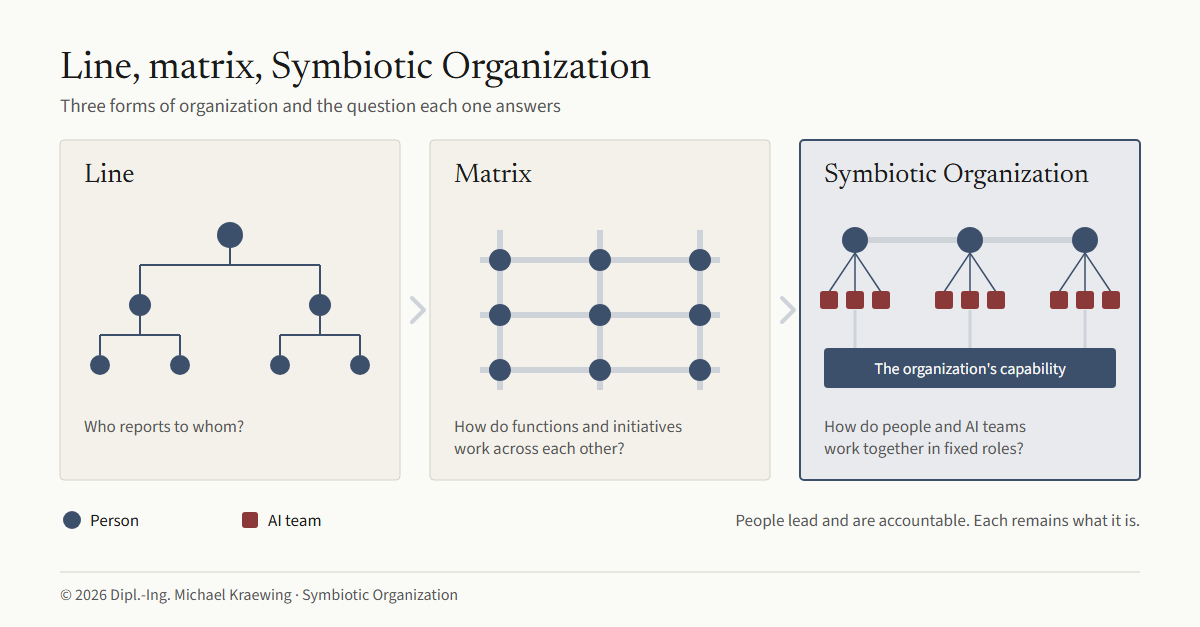
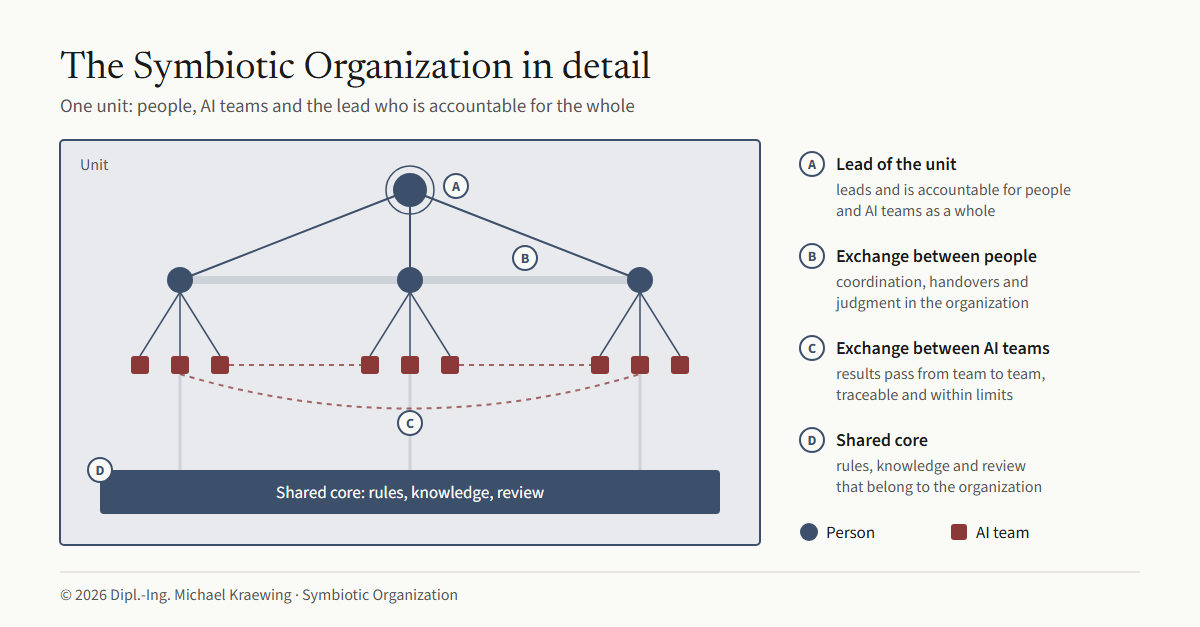
Other terms start from the agent or from scaling agents. In 2025 Microsoft described the "Frontier Firm", in which every employee becomes an "agent boss" who builds and manages their agents. McKinsey describes the "agentic organization" with small teams that own and oversee AI workflows. The Symbiotic Organization puts the question of accountability first. Where does the capability sit, who owns it, and how is it reviewed? In 2024 Vegard Kolbjørnsrud put a thought that fits: "Replacing intelligent humans with intelligent machines does not make an organization more intelligent, but rather more efficient."
Three levels of AI capability
Where does the capability sit today? I distinguish three levels.
- Individual competence. A sales representative writes proposals with a chat tool. He has to prompt, extract and rework every result one by one, and the effort comes back with every proposal. When he leaves, the capability leaves with him.
- Team. The sales team has a fixed way of working. It is clear who drafts with AI, who reviews and who approves, and there are shared templates. A new colleague learns this way of working instead of reinventing it.
- Organization. Rules, knowledge stores and measurement apply across all teams. The capability stays when people leave.
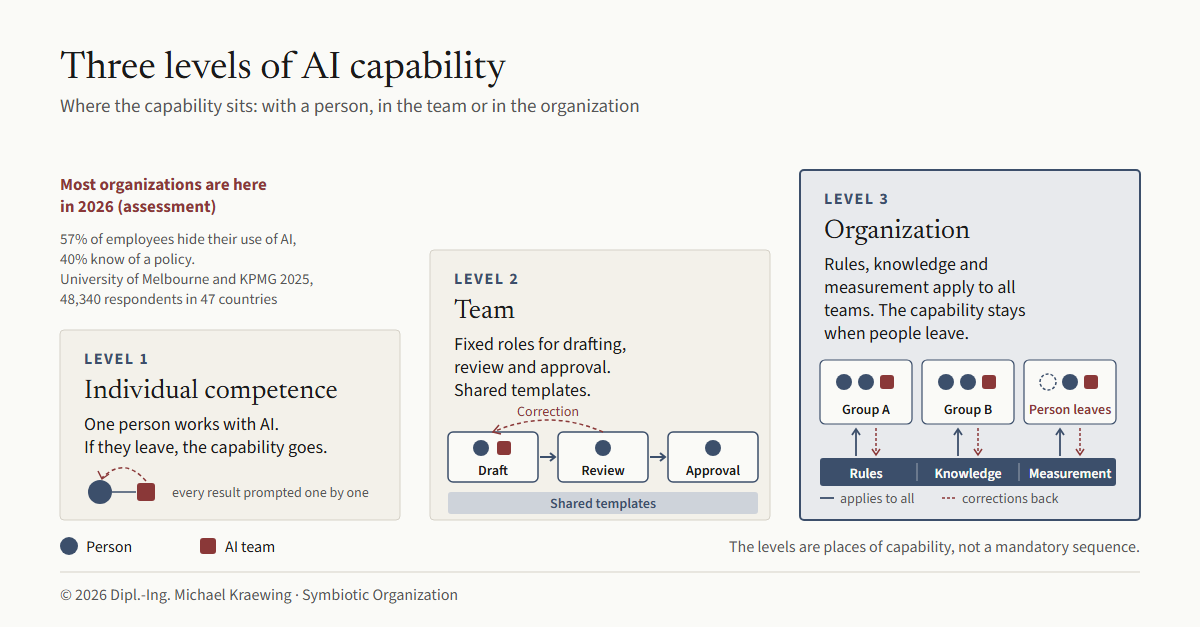
In my assessment, most organizations in 2026 are at level 1 and already call it capability. A study by the University of Melbourne with KPMG fits this. It surveyed 48,340 people in 47 countries. 57 percent of employees said they hide their use of AI at work, and only 40 percent said their employer has a policy on it. The use is there. The organization's capability is not.
Two qualifications belong here. The levels describe where the capability sits; they are not a mandatory sequence. And the step from level 1 to level 2 first costs performance, because roles and review take effort. Anyone introducing AI today should therefore not start at level 1 but with a team and fixed roles. Level 1 feels easy, but it does not lead anywhere by itself.
Four variables and two starting points
There is no blueprint for every organization. Size and industry help with orientation, but four variables determine the answer.
- Coupling of units. How many processes, data and systems do the units share, up to common systems such as the ERP and the teams that run them?
- Knowledge intensity. Is the work routine, or is it judgment, experience and interpretation?
- Regulation. How much do law, supervision, liability and co-determination prescribe?
- Autonomy. How independently do the human units act, and how independently may the AI act?
There are also two starting points. Let us picture them with a house. The first starting point is renovation. An old house gets new plumbing while people live in it. People, processes, systems and contracts are in place, and every change meets what already exists. The second starting point is the greenfield, for example a spin-off. There is no legacy, but also no stock of knowledge, customers and routines.
For the greenfield there is a pointer from innovation research, not from AI research. In 2004 O'Reilly and Tushman studied 35 initiatives. Of those in separate units that kept tight links to senior leadership, more than 90 percent succeeded; of the entirely detached ones, none did. I have seen myself that the link at the top is not enough. In one spin-off, building, tasks and teams were separate, but the ERP system and the team behind it stayed with the parent, with its agenda and pace. For a Symbiotic Organization on the greenfield this means it needs its own stores, its own review and its own AI roles. The Symbiotic Organization on the greenfield does not replace the renovation of the core business; it comes before it or runs alongside. How the four variables and the starting point lead to the right answer, I will show in the next posts.
Four theses
Thesis 1. Mechanics central, domain local. "Central or decentral" is the wrong question. The few shared rules, the role descriptions, the form of the evidence, law and security belong in the center. Expertise, use cases and the rules of the organizational unit stay local. Improvements flow back into the shared core at a fixed rhythm. The weighting must be clear. In 1999 Hansen, Nohria and Tierney found in knowledge management at consulting firms that one clearly leading strategy works better than two of equal weight.
Thesis 2. The autonomy of AI grows with auditability, not with model quality. A minimum model quality is the condition for starting at all. How far the AI may then act without individual approval is set by auditability. That means a complete record of what the AI did, when and on what basis, fixed limits for its actions, and the way back to human operation. Feng, McDonald and Zhang also describe autonomy in 2025 as a design decision, independent of the model's capability. For high-risk systems, EU law points in the same direction. Article 14(3) of the AI Act states that "the oversight measures shall be commensurate with the risks, level of autonomy and context of use". The article does not mention model quality. Outside the EU the thesis is a design rule.
Thesis 3. The organization's memory is a question of ownership. Technically, it is no problem for a system to learn from corrections. But companies buy licenses that deliver a model and an interface, not an organizational memory. Rules, knowledge and counted corrections belong neither to IT nor to the business unit, and no vendor sells them. This fits the MIT report's finding that most systems do not learn from feedback. Who owns that learning, the report does not say; that is my conclusion. In my own working practice this ownership has been with me from the start. In a company it must be assigned, one person from the line in each unit and a small circle from the business, IT, legal and HR for the shared core.
Thesis 4. The experienced expert is the key figure. Brynjolfsson, Li and Raymond studied 5,179 customer support agents. Novices with an AI assistant resolved 34 percent more cases per hour; among experienced agents there was hardly any effect. In a study by METR, 16 experienced developers took 19 percent longer with AI and believed afterwards that they had been 20 percent faster. The expert's lead shrinks and his status comes under pressure. At the same time he is the reviewer the organization needs. Dratsch and colleagues showed radiologists supposed AI suggestions. With correct suggestions, very experienced radiologists were right in 82.3 percent of cases, with wrong ones only in 45.5 percent; inexperienced ones fell from 79.7 to 19.8 percent. Experience protects, but not enough. Review needs experience and a procedure. Whoever fails to win the expert loses review competence and support. Every role that works with AI therefore needs a share of work without AI, so that the ability to review is preserved.
What my own practice shows and what it does not
My own working practice with AI teams on several computers is a small Symbiotic Organization, built on the greenfield. It shows that fixed roles, a shared state and approval by a person hold up in daily work. It does not show what happens in organizations with many people when budgets, positions and influence shift. For these questions my experience from program leadership and the research on human and AI collaboration carry the argument. I have not yet found a study on winners and losers at the level of departments.
What this means for an existing organization
Three questions come up while reading. Here are my answers for orientation.
Where do we stand? Three test questions are enough for a first assessment. Does the capability stay when the most active person leaves? Is there, for one AI-supported process, a written split of who drafts, who reviews and who approves? Are corrections counted, and do they flow back? Three times no means level 1. A yes to the second question points to level 2, a yes to all three to level 3.
Who guards the rules, the PMO for example? The PMO fits the mechanics of thesis 1 well. It can look after the role descriptions, the form of the evidence and the rhythm of feeding improvements back. It does not guard the expertise, which stays in the line, and under thesis 3 ownership of a unit's memory sits there too. Otherwise the capability turns into a project with an end date. How a PMO can itself become one of the first teams with fixed roles, I will show in one of the next posts.
Whom do we involve first? The experienced experts, because they will be the reviewers (thesis 4). Where co-determination applies, the works council belongs at the table early as well.
Key takeaways
- On average, human plus AI does worse than the better of the two alone, especially on decision tasks. Settle the roles before you roll out.
- Use is not yet capability. An organization is capable only when the know-how stays when people leave.
- How much room the AI gets is set by auditability, not by model quality alone.
- The organization's memory needs owners, one person per unit and a small circle for the shared core. Name them.
- Win over your experts. Without them, no one reviews well enough.
Hand out roles, not just licenses. That is the core of a Symbiotic Organization.
What comes next
I am developing the concept further, with target pictures for different starting points and the path to get there. I will present parts of it here in the coming weeks. If your organization faces this question, or if you see one of the four theses differently, I would be glad to hear from you.
Sources
- Vaccaro, M.; Almaatouq, A.; Malone, T. (2024). When combinations of humans and AI are useful: A systematic review and meta-analysis. Nature Human Behaviour 8(12), 2293 to 2303. https://pmc.ncbi.nlm.nih.gov/articles/PMC11659167/
- Challapally; Pease; Raskar; Chari (2025). The GenAI Divide: State of AI in Business 2025. MIT NANDA, preliminary report, not peer reviewed. https://mlq.ai/media/quarterly_decks/v0.1_State_of_AI_in_Business_2025_Report.pdf
- Gillespie, N.; Lockey, S. et al. (2025). Trust, attitudes and use of artificial intelligence: A global study 2025. University of Melbourne and KPMG. https://figshare.unimelb.edu.au/articles/report/Trust_attitudes_and_use_of_artificial_intelligence_A_global_study_2025/28822919
- Regulation (EU) 2024/1689 (AI Act), Article 14. https://eur-lex.europa.eu/eli/reg/2024/1689/oj/eng ; read in the reprint https://artificialintelligenceact.eu/article/14/
- O'Reilly, C. A.; Tushman, M. L. (2004). The Ambidextrous Organization. Harvard Business Review, April 2004. https://hbr.org/2004/04/the-ambidextrous-organization
- Hansen, M. T.; Nohria, N.; Tierney, T. (1999). What's Your Strategy for Managing Knowledge? Harvard Business Review, March/April 1999. https://hbr.org/1999/03/whats-your-strategy-for-managing-knowledge
- Feng; McDonald; Zhang, University of Washington (2025). Levels of Autonomy for AI Agents. arXiv 2506.12469. https://arxiv.org/html/2506.12469v2
- Brynjolfsson, E.; Li, D.; Raymond, L. (2023). Generative AI at Work. NBER Working Paper 31161. https://www.nber.org/papers/w31161
- METR (2025). Measuring the Impact of Early-2025 AI on Experienced Open-Source Developer Productivity. https://metr.org/blog/2025-07-10-early-2025-ai-experienced-os-dev-study/
- Dratsch, T. et al. (2023). Automation Bias in Mammography: The Impact of Artificial Intelligence BI-RADS Suggestions on Reader Performance. Radiology. https://pubs.rsna.org/doi/10.1148/radiol.222176
- Kolbjørnsrud, V. (2024). Designing the Intelligent Organization: Six Principles for Human-AI Collaboration. California Management Review 66(2), 44 to 64. https://cmr.berkeley.edu/assets/documents/promo/kolbjornsrud-2023-designing-the-intelligent-organization-six-principles-for-human-ai-collaboration.pdf
- Microsoft (2025). The 2025 Annual Work Trend Index: The Frontier Firm is born. Vendor publication. https://blogs.microsoft.com/blog/2025/04/23/the-2025-annual-work-trend-index-the-frontier-firm-is-born/
- Sukharevsky, A.; Krivkovich, A.; Gast, A. et al. (2025). The agentic organization: Contours of the next paradigm for the AI era. McKinsey. Consultancy publication, read via a secondary source. https://www.mckinsey.com/capabilities/people-and-organizational-performance/our-insights/the-agentic-organization-contours-of-the-next-paradigm-for-the-ai-era